Topics Covered:
Helpful tools for this guide
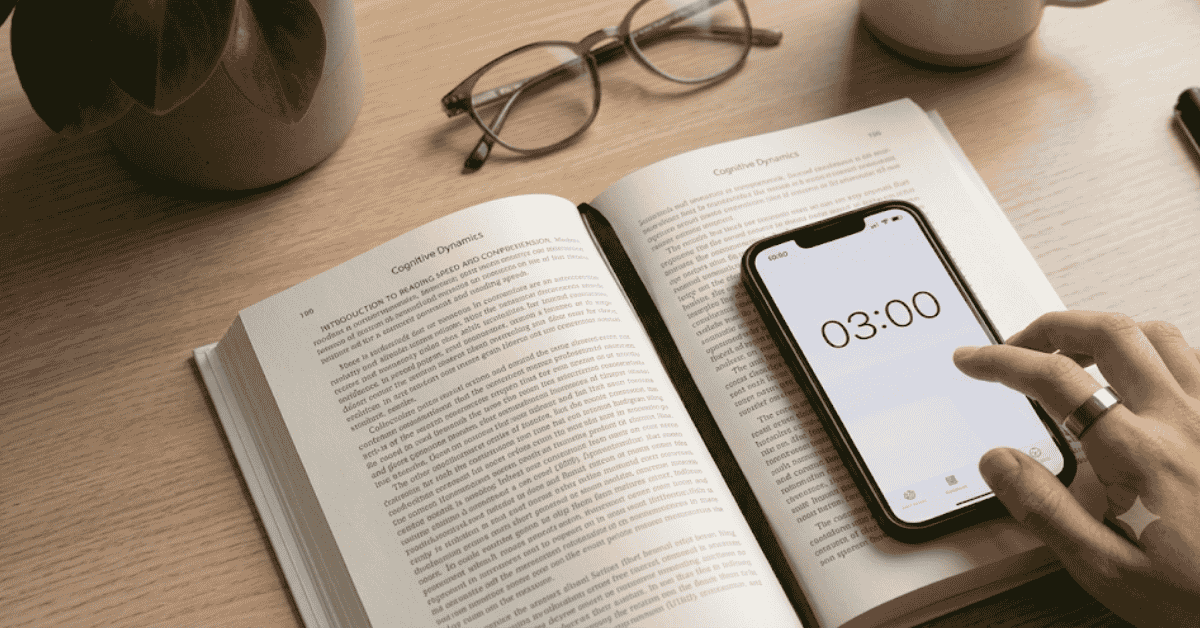
Type "fast reading test" into Google and you'll get two very different kinds of results: a state-administered exam for school kids, and a personal words-per-minute check for everyone else. This guide is the second kind. In about 3 minutes, with nothing but a stopwatch and a passage you haven't read before, you can get an honest estimate of your reading speed and check whether you actually understood what you read.
Treat the result as a practical personal benchmark, not a standardized educational or clinical assessment. Your pace changes with text difficulty, familiarity, language, reading purpose, and how carefully you are trying to understand the material.
Is This the Same as the Florida FAST Reading Test?
No. Florida's FAST (Florida Assessment of Student Thinking) Reading test is a state-administered exam for students in grades 3–10, given through their school. If that's what you're looking for, your child's school or district testing office is the right place to go — practice materials for that exam are not covered here.
This page covers a different, much more informal use of the same phrase: a quick, personal check of how many words per minute (WPM) you read, meant for teens, adults, students, and professionals who just want to know their own pace. No login, no grade level, no score sent anywhere.
Test Your Reading Speed in 3 Minutes
You only need a timer and a passage you haven't read before. Using your own material (a work document, an article you were going to read anyway, a chapter of your current book) makes the result more realistic than a canned test passage.
- Choose a fresh passage. Pick material similar to what you normally read: a news feature, a non-fiction chapter, a report, or a general-interest article.
- Set a timer for 3 minutes. Read at your normal, sustainable pace. Don't deliberately race or skim — that measures a sprint, not your usual reading.
- Mark your stopping point the moment the timer ends.
- Count only the words you actually read. Paste that portion into the CountFlows Word Counter for an exact count instead of estimating.
- Divide the total by 3 to get your approximate words-per-minute rate.
- Check comprehension. Close the passage and answer the four recall questions in the next section before looking back at the text.
For example, if you read 690 words in three minutes:
690 ÷ 3 = 230 WPM
Your result for that passage is approximately 230 words per minute.
How to Calculate Reading WPM
The formula is:
Words per minute = words read ÷ minutes spent reading
With a three-minute test, divide your total word count by 3. Using a different duration? Divide by the exact number of minutes instead — our full guide to calculating reading WPM walks through the math for any test length.
| Words Read in 3 Minutes | Reading Rate |
|---|---|
| 450 words | 150 WPM |
| 600 words | 200 WPM |
| 714 words | 238 WPM |
| 780 words | 260 WPM |
| 900 words | 300 WPM |
| 1,200 words | 400 WPM |
Check Your Comprehension, Not Just Your Speed
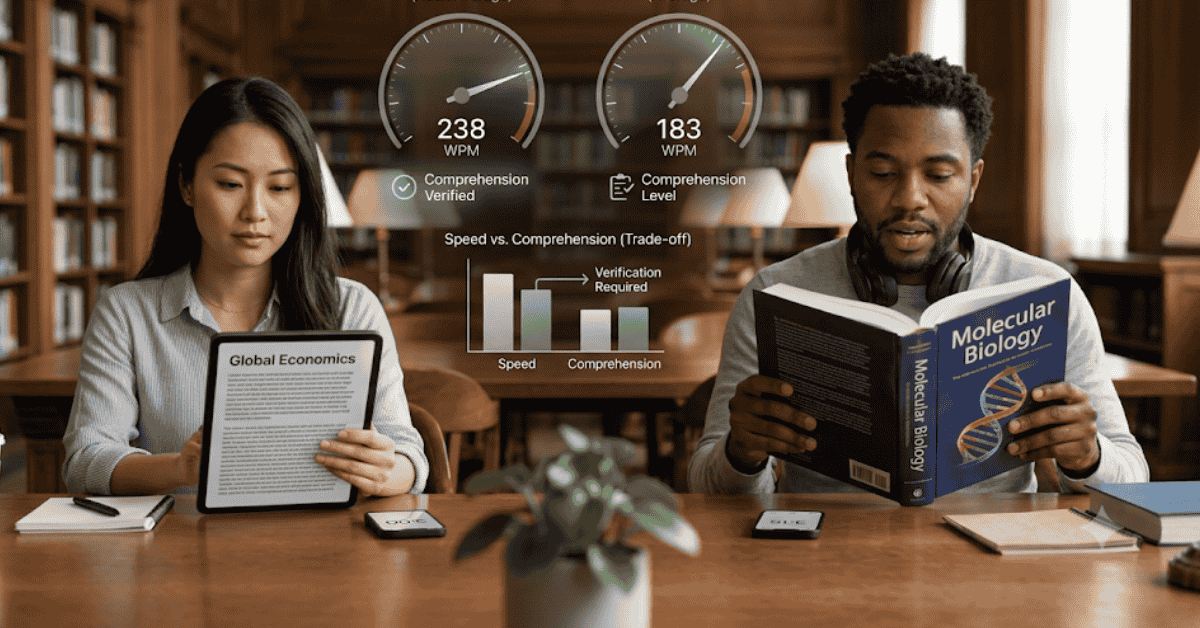
A high number isn't very useful if you can't explain what you just read. Research on speed reading points to a real trade-off between reading faster and holding onto understanding, especially once a reader pushes well past their normal pace.
When the timer ends, close the passage and answer these four questions from memory:
- What was the main point?
- What were two important supporting details?
- What example, fact, or explanation do you remember?
- What conclusion or takeaway did the author give?
Give yourself one point per substantially correct answer, then check the original passage.
| Recall Score | Practical Interpretation |
|---|---|
| 4/4 | Strong recall for this passage |
| 3/4 | Useful comprehension with some detail lost |
| 2/4 | Your pace may be outrunning your understanding |
| 0–1/4 | Retest at a slower, more comfortable pace |
This four-question check is a practical CountFlows method for personal tracking, not a standardized comprehension exam.
What Counts as an Average Reading Speed?
One of the largest reviews of reading-rate research, published by Marc Brysbaert in 2019, examined 190 studies covering 18,573 participants. It put average English silent reading at approximately 238 WPM for non-fiction and 260 WPM for fiction, with average oral reading around 183 WPM. Most adults reading English non-fiction fell roughly between 175 and 300 WPM.
These are group averages, not a pass-or-fail line for any one reader. For the full breakdown by reading situation — skimming, technical material, reading aloud, speeches — see our average reading speed guide.
Read the Brysbaert reading-rate research.
Why Your Score Changes From One Passage to the Next
Reading rate isn't a fixed personal number. The same person can post noticeably different results on different texts.
- Text difficulty: technical or unfamiliar material usually needs more processing.
- Reading purpose: studying for an exam differs from reading a novel for pleasure.
- Prior knowledge: a familiar subject is easier to process quickly.
- Language: reading is often slower outside your strongest language.
- Display and environment: line length, font size, screen size, interruptions, and fatigue all matter.
- Required comprehension: careful study normally takes longer than scanning for one fact.
For useful comparisons over time, test similar material under similar conditions.
A More Reliable Baseline: Run Three Tests
One passage can be unusually easy or unusually hard, so a single result can be misleading in either direction. Most quick online reading tests only give you that one number from one passage. For a sturdier personal baseline, run the 3-minute method three separate times on fresh passages of similar difficulty, then average the results.
| Test | Result |
|---|---|
| Test 1 | 218 WPM |
| Test 2 | 236 WPM |
| Test 3 | 226 WPM |
| Average | 227 WPM |
(218 + 236 + 226) ÷ 3 = 227 WPM
This isn't a standardized testing protocol — it's simply a better personal tracking method than treating one passage as your permanent reading speed.
Manual Test vs. Automatic Online Reading Tests
Plenty of sites offer a one-click reading test: hit start, read a fixed passage, hit stop, get an instant number. They're convenient, but that convenience comes with a trade-off — you're being timed on text you didn't choose, which may not represent how you actually read day to day.
The manual method in this guide takes a little longer, but it lets you test with material that actually matters to you: the report you're about to read, the textbook chapter due tomorrow, the email backlog you're clearing. That's usually a more honest number than a generic sample paragraph.
Want the convenience without losing that accuracy? Time yourself once using the method above to find your personal WPM, then plug that number into the CountFlows Reading Time Calculator to instantly estimate how long any future document, article, or book will take you — using your real pace instead of a generic average.
Is a Very High WPM Score Realistic?
A high number doesn't automatically mean better reading. Keith Rayner and colleagues reviewed decades of research on normal and speed reading and concluded there's a genuine trade-off between speed and comprehension — dramatically doubling or tripling your normal pace while keeping the same depth of understanding is unlikely. Their review describes typical skilled reading as commonly falling around 200 to 400 WPM.
If your result looks unusually high, ask yourself honestly whether you understood the full passage, or mainly picked up headings, keywords, and the general gist.
How to Interpret Your Result Without Turning It Into a Grade
| Your Result | Useful Interpretation |
|---|---|
| Below 175 WPM | Below the broad adult non-fiction range reported by Brysbaert, though text difficulty, language, and purpose all matter. |
| 175–300 WPM | Within the broad range reported for most adult English non-fiction reading. |
| 300–400 WPM | Faster than the overall non-fiction average — worth double-checking your comprehension score. |
| Above 400 WPM | Higher than typical careful reading for many adults. A comprehension check helps tell deep reading from scanning. |
These bands aren't diagnostic. Someone carefully studying a legal, medical, or academic text may read much more slowly for good reasons.
Making Your Test Repeatable
If you want to track progress over several weeks, keep conditions as similar as possible:
- Use a fresh passage each time.
- Keep subject difficulty roughly similar.
- Use the same test duration.
- Use the same device when practical.
- Test somewhere reasonably quiet.
- Record both WPM and your recall score.
- Avoid passages you already know well.
A simple tracking sheet with date, passage type, word rate, recall score, and a note on difficulty gives you far more useful information than a speed number on its own.
Can You Read Faster Without Losing Comprehension?
Some improvement is realistic, but there's no credible universal percentage every reader should expect. Vocabulary, reading experience, topic familiarity, concentration, and practice all affect efficiency. Research doesn't support the idea that most readers can simply multiply their normal pace while preserving the same depth of comprehension.
A more useful goal is becoming more efficient while checking that understanding holds steady. For practical techniques, see our guide on how to read faster without losing comprehension.
Turn Your Score Into a Reading-Time Estimate
Once you have a reasonable personal baseline, use it to estimate how long an article, report, chapter, or book will take. At 238 WPM, 10,000 words takes about 42 minutes of continuous reading; at 200 WPM, the same 10,000 words takes about 50 minutes — see the full breakdown in how long it takes to read 10,000 words .
Use the CountFlows Reading Time Calculator to estimate reading duration for any text at your own pace, or the generic average.
Common Mistakes That Make a Test Less Useful
- Using a familiar passage: prior knowledge makes material easier to process quickly.
- Racing for a personal record: that measures a sprint, not your normal sustainable pace.
- Ignoring comprehension: a high number can hide shallow processing or scanning.
- Comparing unrelated text types: a technical paper and a light novel aren't equivalent tests.
- Testing only once: one passage may not represent your usual performance.
- Changing the method each time: inconsistent timing and conditions make trends harder to read.
FAQ
Is a reading speed test the same as the Florida FAST Reading test?
No. Florida's FAST Reading test is a state-administered school exam for grades 3–10. A reading speed test like this one is an informal, personal WPM check anyone can run on their own.
What's considered a good reading speed test score?
Research puts most adult English non-fiction reading between roughly 175 and 300 WPM, so a result in that range is typical. What matters more than the number is whether your comprehension score holds up.
Is 400 WPM a fast reading test score?
Yes — it's faster than the overall non-fiction average reported by Brysbaert's 2019 review. At that pace, double-check comprehension to confirm you're not just skimming.
Can I retest to check improvement?
Yes, but use a fresh passage each time. Retesting on a passage you've already read inflates your score without reflecting a real speed change.
Do reading speed tests measure comprehension?
A speed-only number does not. Pair it with a short recall check, like the four-question method in this guide, to see whether your speed is coming at the cost of understanding.
How long should a reading speed test passage be?
Long enough to sustain 3 minutes of normal reading — typically 600 to 900 words for an average adult pace. Shorter passages make the per-minute math noisier.
Research Behind These Numbers
The adult reading-rate figures here come primarily from Marc Brysbaert's 2019 review and meta-analysis of 190 studies involving 18,573 participants. The discussion of speed versus comprehension is supported by the 2016 review from Keith Rayner, Elizabeth Schotter, Michael Masson, Mary Potter, and Rebecca Treiman. Both studies separate measured reading behavior from unusually high speed-reading claims.
Sources: Brysbaert (2019) and Rayner et al. (2016).
A useful reading-speed check needs three things: a timed passage, an exact word count, and a comprehension check. Three minutes is a convenient window for a personal baseline — it's not a standardized scientific test, and it isn't a substitute for Florida's FAST Reading assessment. Use the numbers here for context, not as a target you must beat. The most useful pace is the one at which you can read what actually matters to you and still remember it.
FAQ
Is a reading speed test the same as the Florida FAST Reading test?
No. Florida's FAST Reading test is a state-administered school exam for grades 3–10. A reading speed test like this one is an informal, personal WPM check anyone can run on their own.
What's considered a good reading speed test score?
Research puts most adult English non-fiction reading between roughly 175 and 300 WPM, so a result in that range is typical. What matters more than the number is whether your comprehension score holds up.
Is 400 WPM a fast reading test score?
Yes — it's faster than the overall non-fiction average reported by Brysbaert's 2019 review. At that pace, double-check comprehension to confirm you're not just skimming.
Can I retest to check improvement?
Yes, but use a fresh passage each time. Retesting on a passage you've already read inflates your score without reflecting a real speed change.
Do reading speed tests measure comprehension?
A speed-only number does not. Pair it with a short recall check, like the four-question method in this guide, to see whether your speed is coming at the cost of understanding.
How long should a reading speed test passage be?
Long enough to sustain 3 minutes of normal reading — typically 600 to 900 words for an average adult pace. Shorter passages make the per-minute math noisier.
Research Behind These Numbers
The adult reading-rate figures here come primarily from Marc Brysbaert's 2019 review and meta-analysis of 190 studies involving 18,573 participants. The discussion of speed versus comprehension is supported by the 2016 review from Keith Rayner, Elizabeth Schotter, Michael Masson, Mary Potter, and Rebecca Treiman. Both studies separate measured reading behavior from unusually high speed-reading claims.
Sources: Brysbaert (2019) and Rayner et al. (2016).
A useful reading-speed check needs three things: a timed passage, an exact word count, and a comprehension check. Three minutes is a convenient window for a personal baseline — it's not a standardized scientific test, and it isn't a substitute for Florida's FAST Reading assessment. Use the numbers here for context, not as a target you must beat. The most useful pace is the one at which you can read what actually matters to you and still remember it.
Related Articles
Continue with closely related CountFlows guides.
Writing & Education
Academic Writing Guide: Structure, Examples & Tips for Students
A practical guide to academic writing, including structure, evidence, paragraph building, assignment command words, examples, citations, and editing.
Writing & Education
Essay Word Count Guide: How Long Is an Essay? (By Level)
Word count problems start at the outline stage, not the writing stage. Learn essay lengths by level, paragraph word counts, the exact 10% rule for common lengths, and where your word count actually goes.
Writing & Education
How Many Pages Is 2,000 Words? Single & Double Spaced
A standard page holds about 500 words single-spaced or 250 words double-spaced. See page estimates for essays, books, handwriting, speeches, and common word counts.