Topics Covered:
Helpful tools for this guide
Table of Contents
- Developer Cheat Sheet: Quick Naming Guide
- camelCase vs PascalCase vs snake_case at a Glance
- What Is camelCase?
- What Is PascalCase?
- What Is snake_case?
- The API Dilemma: Frontend vs. Backend Naming Collisions
- Direct Comparisons
- PascalCase vs camelCase
- camelCase vs snake_case
- snake_case vs PascalCase
- What Is kebab-case?
- Advanced CSS: The BEM Methodology
- Other Naming Styles Worth Knowing
- Naming Styles by Programming Language
- Common Mistakes to Avoid
- How to Convert Cases Programmatically (Regex)
- How to Switch Between Naming Styles Instantly
- Why This Actually Matters
- FAQs
- Is snake_case the exact same as underscore case?
- What naming style does Python use?
- Can I mix styles in one project?
- What's the difference between camelCase and PascalCase?
- Is PascalCase the same as Pascal notation?
- Is there a standard naming style for JSON payloads?
- Bottom Line
A pull request is blocked because a linter complains about inconsistent naming. Three variables in the same file use three different styles. A case converter can fix the formatting quickly, but it won't explain why the styles differ or when to use camelCase, PascalCase, snake_case, or kebab-case.
If you write code, design databases, build APIs, or name project files, knowing these naming conventions is absolutely essential. This guide explains the main programming cases, the technical differences between them, and exactly where developers use each one.
Developer Cheat Sheet: Quick Naming Guide
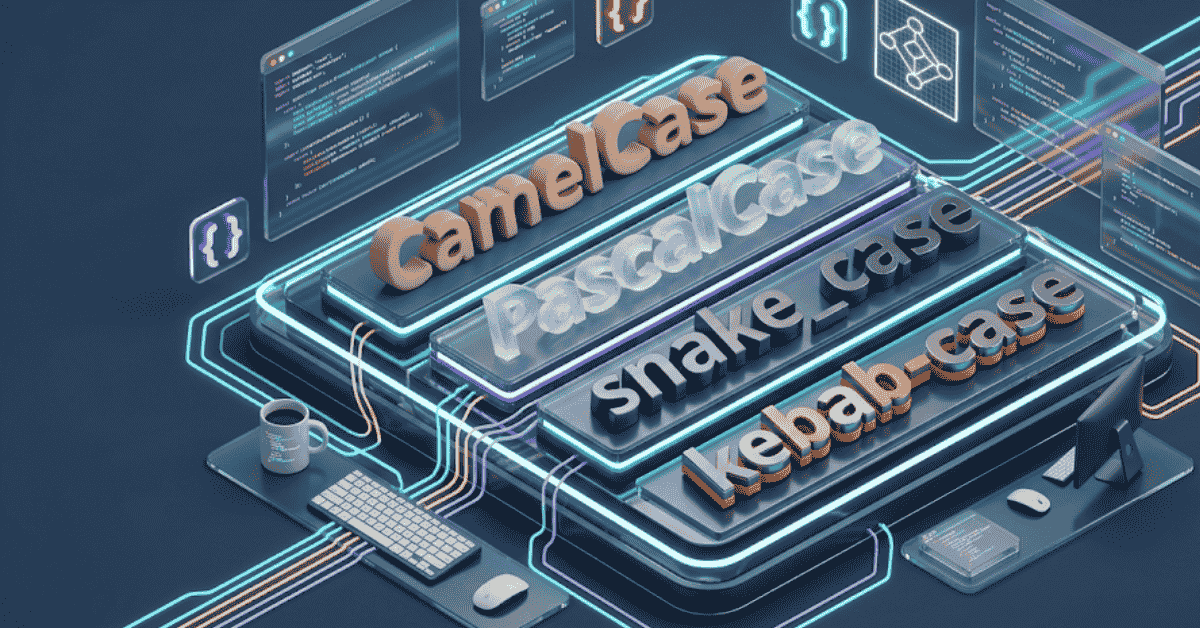
- camelCase: Starts lowercase, capitalizes next words. Example: userFirstName
- PascalCase: Capitalizes every word, including the first. Example: UserFirstName
- snake_case: All lowercase, separated by underscores. Example: user_first_name
- kebab-case: All lowercase, separated by hyphens. Example: user-first-name
Need to switch between these instantly without writing a script? Use our Free Case Converter Tool.
camelCase vs PascalCase vs snake_case at a Glance
| Style | Example | How Words Are Separated | Common Use Cases |
|---|---|---|---|
| camelCase | userName | Capital letters | Variables and functions (JavaScript, Java) |
| PascalCase | UserName | Capital letters (including first) | Classes, types, and components (C#, React) |
| snake_case | user_name | Underscores (_) | Python, Ruby, APIs, and SQL Databases |
| kebab-case | user-name | Hyphens (-) | URLs, CSS, and file names |
What Is camelCase?
camelCase takes two or more words and joins them without spaces. The first word stays completely lowercase, while every subsequent word starts with a capital letter. That is the entire rule.
JavaScript, Java, C++, and C# developers commonly use camelCase for variables, methods, and functions. If you have ever written variable names like userAge, calculateTotalSum, or isLoggedIn, you have naturally used it. Since there are no external separators between words, camelCase keeps your codebase dense and compact.
What Is PascalCase?
PascalCase is almost identical to camelCase. The only difference is that the very first letter is capitalized too. So, taskTitle becomes TaskTitle.
C#, Java, and TypeScript commonly use PascalCase for classes, interfaces, enums, and types. When you see a name like TaskItem or DatabaseConnection, the capitalization gives you an immediate visual clue that you are looking at a class or a type definition, rather than a standard variable.
Modern frontend frameworks also heavily rely on PascalCase. React components must use PascalCase (such as TaskCard.jsx) so the compiler can distinguish them from standard HTML tags. Vue projects may use PascalCase or kebab-case depending on the team's specific naming architecture.
What Is snake_case?
snake_case keeps all words lowercase and separates them strictly with underscores. For example, taskTitle becomes task_title.
Python's official style guide, PEP 8, explicitly recommends snake_case for variables and functions. Ruby, Rust, and PHP developers also commonly follow this pattern.
Beyond programming languages, relational databases heavily rely on snake_case. Table and column names like user_id and created_at are industry standard, primarily because many older SQL databases handle capitalization unpredictably. Using underscores prevents syntax errors.
The API Dilemma: Frontend vs. Backend Naming Collisions
Because different languages prefer different casing, building web applications often creates a naming collision. A JavaScript frontend naturally uses camelCase (userId), but a Python or Ruby backend uses snake_case (user_id).
When transferring data via JSON APIs, teams usually pick one of two solutions:
- Standardize the JSON payload: The team agrees to use snake_case for all JSON responses, forcing the frontend to map
response.user_idto its internaluserIdstate. - Use automated serialization: Backend frameworks can automatically intercept outgoing data and convert it. For example, Python's Pydantic allows you to write
user_idin your database model but automatically outputuserId(camelCase) to the frontend via alias generators.
Direct Comparisons
PascalCase vs camelCase
Both styles join words without spaces. camelCase starts with a lowercase letter (userProfile), while PascalCase starts with a capital letter (UserProfile). Variables and functions usually use camelCase; classes, types, and UI components commonly use PascalCase.
camelCase vs snake_case
camelCase marks new words with capital letters, while snake_case separates them with underscores. For example, firstName vs first_name. The better choice always depends on the official conventions of the programming language you are currently writing.
snake_case vs PascalCase
snake_case uses lowercase words separated by underscores (user_profile). PascalCase removes all separators and capitalizes each word (UserProfile). Python developers commonly use snake_case for variables and switch to PascalCase specifically for declaring classes.
What Is kebab-case?
kebab-case works a lot like snake_case, but it replaces underscores with hyphens (dashes). For example, task_title becomes task-title.
You almost never use kebab-case for variables in programming languages because compilers and interpreters read the hyphen as a subtraction/minus sign, which triggers an immediate syntax error.
Instead, kebab-case is standard for URLs (slugs), file names, CSS class names, and command-line flags (like --dry-run). Custom HTML elements also require a hyphen in their names, such as <task-card>.
Advanced CSS: The BEM Methodology
If you write CSS, you will likely encounter BEM (Block, Element, Modifier). BEM is a highly specific naming convention that mixes snake_case and kebab-case rules to keep large stylesheets organized.
- Block: The standalone entity (
card). - Element: A part of the block, separated by two underscores (
card__title). - Modifier: A specific state, separated by two hyphens (
card__title--active).
While BEM looks intimidating at first, it prevents CSS scoping conflicts across massive web applications.
Other Naming Styles Worth Knowing
- SCREAMING_SNAKE_CASE: Also called CONSTANT_CASE. It follows snake_case but uses all capital letters. It is strictly used for global constants, such as
MAX_LOGIN_ATTEMPTS. - Train-Case: Works exactly like kebab-case, but every word starts with a capital letter (
Task-Title). - dot.case: Separates words with periods. You will see it heavily in configuration files and package names.
If you want the rules for normal human writing—such as blog headlines and sentences—read our guide: What Is Sentence Case?
Naming Styles by Programming Language
| Language / Context | Variables & Functions | Classes & Types | Constants |
|---|---|---|---|
| JavaScript / TS | camelCase | PascalCase | SCREAMING_SNAKE_CASE |
| Python | snake_case | PascalCase | SCREAMING_SNAKE_CASE |
| Java | camelCase | PascalCase | SCREAMING_SNAKE_CASE |
| C# | camelCase (locals) | PascalCase | PascalCase |
| CSS & HTML | kebab-case | N/A | N/A |
| URLs & Files | kebab-case | N/A | N/A |
| Ruby | snake_case | PascalCase | SCREAMING_SNAKE_CASE |
| SQL Databases | snake_case | N/A | N/A |
Common Mistakes to Avoid
- Switching styles midway: One function might be called
fetchTaskswhile another isfetch_tasks. Always follow the established convention of your language or repository. - Wrong constant casing: In many projects, a constant written as
MaxRetriesshould actually beMAX_RETRIES. - Inconsistent acronyms: Names such as
taskIDandtaskIdmay both appear in code. Pick one and enforce it via your linter.
How to Convert Cases Programmatically (Regex)
If you are building an application and need to convert string cases automatically, developers typically rely on Regular Expressions (Regex). For example, converting snake_case to camelCase in JavaScript looks like this:
const snakeToCamel = (str) =>
  str.replace(/_([a-z])/g, (match, letter) => letter.toUpperCase());

console.log(snakeToCamel('user_first_name')); // Output: userFirstName
How to Switch Between Naming Styles Instantly
While Regex is great for automated code processes, renaming dozens of JSON keys or database variables from snake_case to camelCase by hand is incredibly slow, and a single typo can break a production build.
Our Free Case Converter switches text between camelCase, PascalCase, snake_case, and kebab-case instantly. It runs entirely locally in your browser, meaning your proprietary code is never sent to an external server.
If you are working in a spreadsheet instead of an IDE, read our guide on how to convert case in Excel.
Why This Actually Matters
A consistent naming style turns a variable name into a clue. PascalCase immediately tells a developer they are looking at a class before they even open its definition file. SCREAMING_SNAKE_CASE acts as a giant warning sign that a value should never be reassigned dynamically.
Breaking these patterns makes code reviews slower, searching harder, and refactoring a nightmare. getUserName and get_user_name are fundamentally different strings to a computer, even though they mean the exact same thing to a human.
FAQs
Is snake_case the exact same as underscore case?
Yes. Both terms describe lowercase words separated by underscores, such as user_name.
What naming style does Python use?
Python's PEP 8 style guide strictly recommends snake_case for variables, methods, and functions, while class names must use PascalCase.
Can I mix styles in one project?
While the code may compile, inconsistent naming makes a project incredibly hard to read and maintain. It will also likely fail CI/CD linting checks. Stick to one standard per project.
What's the difference between camelCase and PascalCase?
The only difference is the first letter. camelCase starts lowercase (taskTitle), while PascalCase starts with a capital letter (TaskTitle).
Is PascalCase the same as Pascal notation?
Yes. PascalCase, Pascal casing, and Pascal notation are interchangeable terms describing the style where every word begins with a capital letter with no separators.
Is there a standard naming style for JSON payloads?
JSON doesn't enforce a single style. However, camelCase is the standard for JavaScript APIs, while snake_case is heavily prevalent in APIs built with Python, Ruby, or Go.
Bottom Line
camelCase, PascalCase, snake_case, and kebab-case all solve the exact same problem: writing multiword names without breaking syntax with spaces. The right choice always depends on the programming language, the framework, or your team's existing style guide.
Consistency matters far more than personal preference. If you need to map large datasets or variables between these formats, don't rewrite them manually—use a Case Converter Tool to handle it programmatically instantly.
Related Articles
Continue with closely related CountFlows guides.
Other
Cover Letter Word Count: Exact Length That Gets Interviews
Discover the ideal cover letter length, word count guidelines by experience level, and proven tips to write a cover letter that gets noticed.
Other
Keyboard Shortcut for Word Count in Text, Docs & Vim
One-press shortcuts for word count across Word, Google Docs and Vim—how to view live counts and dialog boxes quickly.
Other
How to Check Word Count in Google Docs (Complete Guide)
Learn how to view word count in Google Docs on desktop, mobile and for selected text, plus keyboard shortcuts and live counter tips.